
Our approach to net zero
The impact of climate change affects us all, and scientific evidence is clear urgent action is needed. An important part of our strategy to reshape M&S for sustainable, profitable growth is our ambition to become a net zero business across our value chain by 2040, supported by Science Based Targets initiative (SBTi)-validated science-based targets aligned to limit global warming to 1.5°C.
Acting decisively protects our supply chain, our customers and the value we deliver as a business for the long term.
Our targets include a 55% reduction in Scope 1 and 2 emissions, a 30% reduction in Scope 3 FLAG (Forestry, Land and Agriculture) emissions, a 42% reduction in Scope 3 non-FLAG emissions, and other targets that support our net zero and wider ESG ambitions.
In line with SBTi guidance for businesses with FLAG emissions, our targets include FLAG and non-FLAG emissions targets, these targets have been validated by the SBTi.
Efficient operations (Scope 1 and 2)
Our stores and logistics fleet are the parts of our value chain we have the greatest control over. We are focused on electrifying, switching to renewables and improving energy efficiency in our operations.
We continue to invest in our store estate, warehouses and logistics fleet to reduce our operational emissions. Our standardised store specification ensures a strategic estate-wide approach to lowering emissions, including LED lighting, fully electric heating and fridge doors. LED conversions have now been completed in the majority of sites, and HVAC system upgrades continue.
Across logistics, we have 215 bio-CNG vehicles. Almost 15% of our total owned fleet transport kilometres are now delivered by lower-emission solutions.
We have also commissioned HGV charging hubs in Welham Green, Swindon and Castle Donington, enabling additional battery-electric HGV routes and expanding the operational footprint of our zero-tailpipe-emission fleet. Through the Plan A Accelerator Fund, we are trialling an Air Source Heat Pump in Welham Green to test whether the technology can directly replace gas boilers.
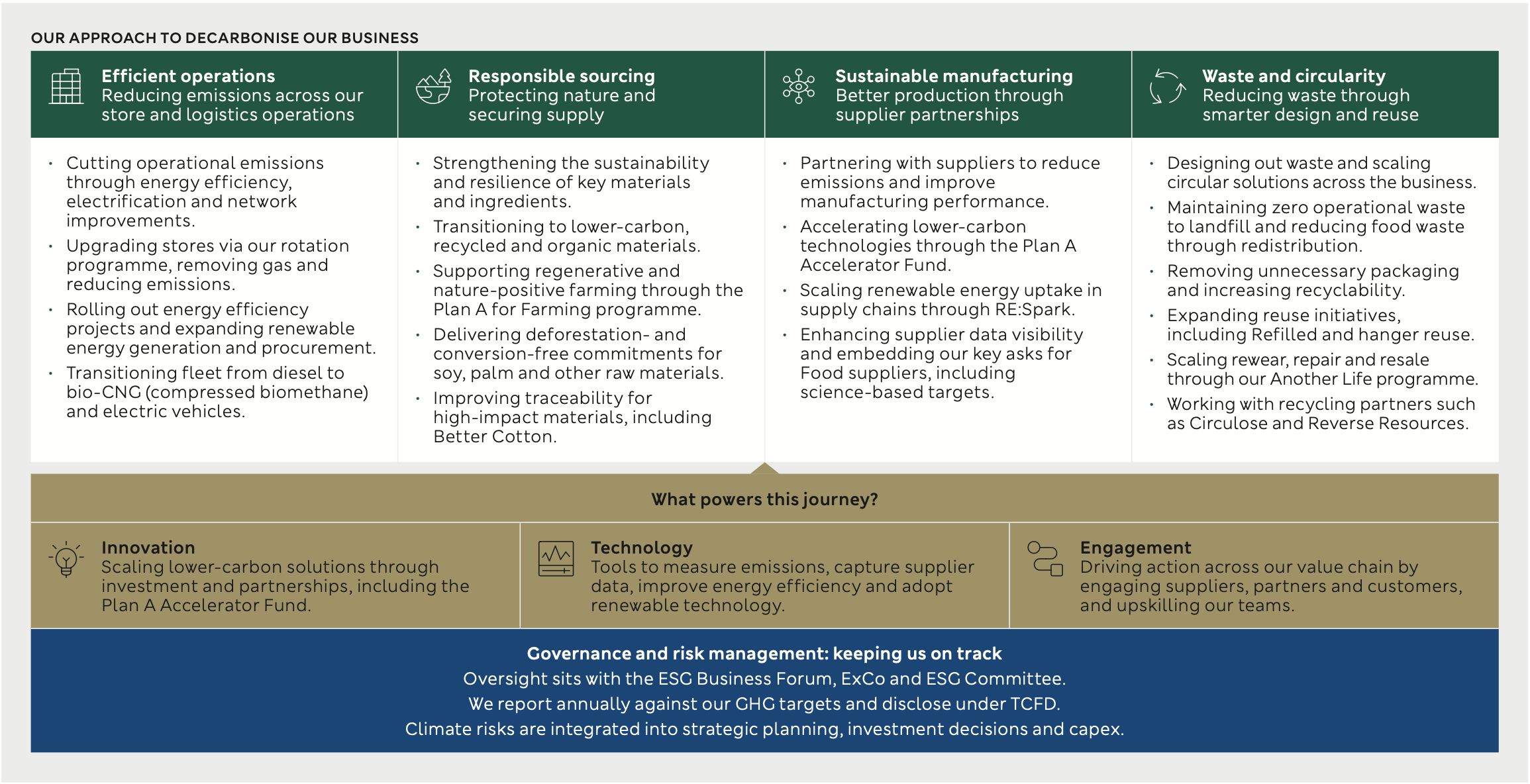
Reducing emissions across our store and logistics operations
- Cutting operational emissions through energy efficiency, electrification and network improvements.
- Upgrading stores via our rotation programme, removing gas and reducing emissions.
- Rolling out energy efficiency projects and expanding renewable energy generation and procurement.
- Transitioning fleet from diesel to bio-CNG (compressed biomethane) and electric vehicles.
Protecting nature and securing supply
- Strengthening the sustainability and resilience of key materials and ingredients.
- Transitioning to lower‑carbon, recycled and organic materials.
- Supporting regenerative and nature‑positive farming through the Plan A for Farming programme.
- Delivering deforestation and conversion‑free commitments for soy, palm and other raw materials.
- Improving traceability for high‑impact materials, including Better Cotton.
Better production through supplier partnerships
- Partnering with suppliers to reduce emissions and improve manufacturing performance.
- Accelerating lower‑carbon technologies through the Plan A Accelerator Fund.
- Scaling renewable energy uptake in supply chains through RE:Spark.
- Enhancing supplier data visibility and embedding our key asks for Food suppliers, including science‑based targets.
Reducing waste through smarter design and reuse
- Designing out waste and scaling circular solutions across the business.
- Maintaining zero operational waste to landfill and reducing food waste through redistribution.
- Removing unnecessary packaging and increasing recyclability.
- Expanding reuse initiatives, including Refilled and hanger reuse.
- Scaling rewear, repair and resale through our Another Life programme.
- Working with recycling partners such as Circulose and Reverse Resources.
Innovation is central to how we deliver Plan A and meet our ambition to reach net zero. From piloting lower‑carbon technologies across our operations to testing new farming methods and circular solutions, innovation enables us to cut emissions, strengthen resilience and improve the sustainability of the products we offer. By combining investment, research and supply chain partnerships, we can scale new ideas faster, tackle emerging challenges and build a future‑fit business where low‑impact solutions are the norm.
Accelerator fund
Test-and-trial funding lets us support the technologies that could scale M&S towards net zero faster than business-as-usual would allow. Since 2022, our £1 million-a-year Plan A Accelerator Fund has backed test-and-trial projects that cut carbon, strengthen resilience and unlock new sustainable solutions across our operations and supply chains. We have supported 37 projects, many of which have delivered benefits beyond emissions reduction, including improved soil health, extended UK growing seasons and longer product life.
More information on our past accelerator funded projects can be found below:
- M&S Parsnips in store from retailer's first autonomous field trial
- M&S launches Plan A projects to boost UK-grown fruit and veg
- M&S launches clothes repair service to give quality clothes 'Another Life' through Plan A
- M&S Funding new industry-first innovation projects
- M&S innovating its way to Net Zero through new Plan A partnership funding
- M&S drives carbon reductions with its first autonomous field trial
From targeted trials to wider deployment across logistics, manufacturing and agriculture, technology underpins many of our decarbonisation levers.
In addition, high‑quality, reliable data is equally essential, enabling us to track performance, prioritise action and direct investment where it delivers the greatest impact across our operations and supply chains. We use advanced digital tools to strengthen data quality and visibility.
- Sphera for Scope 1 and 2 data collection. This year we have also brought in some Scope 3 reporting into Sphera.
- Higg Index for better visibility across our supply chain sustainability data in Fashion, Home & Beauty.
- Secaro for Tier 1 Food suppliers to share site‑specific data.
- Mondra for product‑level carbon footprinting for Food, integrating supplier data for greater accuracy.
- EcoVadis to track sustainability performance across our central procurement spend.
Net zero is bigger than any one business. Delivering our ambition requires collective action across our full value chain, from how raw materials are sourced, to how products are made, sold and used.
Our approach is built on collaboration with customers, colleagues, suppliers and wider industry partners, recognising that meaningful emissions reduction depends on shared responsibility and coordinated action at scale.
Customers
We support our customers to make lower‑carbon choices by increasing transparency and encouraging engagement with sustainability.
Through Look Behind the Label, we bring the sustainability stories behind our products to life, helping customers understand the environmental impact of what they buy. We also partner with organisations such as Reboot the Future to create tools and resources that support informed conversations about climate change and more sustainable lifestyles.
Colleagues
Our colleagues play a critical role in embedding net zero into everyday decision-making across the business. We are building carbon literacy at scale, equipping colleagues with the knowledge needed to reduce emissions across sourcing, product design and operations. Initiatives such as our Plan A Immersion days, Knowledge Shares and and Plan A Network help translate ambition into action, while targeted training supports teams to integrate sustainability into product development and sourcing decisions.
Supplier partners
The majority of our emissions sit within our value chain, making supplier engagement essential to delivering net zero.
We are working closely with supplier partners to drive decarbonisation, setting clear expectations and supporting progress through:
- Science-based targets aligned to net zero by 2040
- Transition to 100% renewable electricity
- Adoption of deforestation- and conversion-free commodities
- Improvements in resource use, waste reduction and water management
- Implementation of human rights and environmental standards
Industry collaboration
We recognise that systemic change requires industry-wide action. We work with peers and partners to scale solutions, align standards and accelerate progress.
This includes participation in initiatives such as the Science Based Targets initiative (SBTi), the UN Race to Zero, and the British Retail Consortium Climate Roadmap, helping to drive collective progress towards a low‑carbon economy. Read more about our collaborations and partnerships here
What powers this journey
Our SBTi-validated science-based targets cover the whole value chain.
- Net zero across the value chain by FY 2040.
- Scope 1 and 2: reduce absolute GHG emissions 55% by FY2030 from a FY2017 base year, and 90% by FY2035.
- Scope 3 (non-FLAG): reduce absolute GHG emissions 42% by FY2030 from a FY2023 base year, and 90% by FY2040.
- Scope 3 FLAG: reduce absolute FLAG GHG emissions 30.3% by FY2030 from a FY2023 base year, and 72% by FY2040.
- No deforestation across our primary deforestation-linked commodities, with a target date of 31 December 2025*.
* Our SBTi‑validated deforestation target to 2025 has now concluded. We are reviewing our approach and intend to set an updated target aligned with evolving guidance and regulatory requirements.
While the majority of our emissions sit beyond our direct operations, reducing Scope 1 and 2 emissions remains a key priority, reflecting the areas where we have the greatest level of control. We continue to focus on reducing emissions from our buildings, logistics and operations through energy efficiency and the transition to lower‑carbon energy sources.
Most of our greenhouse gas (GHG) emissions, however, occur across our wider value chain. Scope 3 emissions make up the vast majority of our footprint; driven largely by the production of the goods we sell and how they are used by our customers.
Within Scope 3, purchased goods and services (Category 1) account for the overwhelming share of emissions, representing around 90% of our Scope 3 footprint. This reflects the importance of how raw materials are sourced, how products are made, and the choices made across our supply chain.
Managing these emissions is inherently complex, requiring close collaboration with suppliers, partners and customers across multiple geographies and sectors. We continue to improve the quality and coverage of our data, recognising that this remains an evolving area and that the full impact of our decarbonisation initiatives may not yet be fully captured.
As our business grows, work is underway to ensure our reduction pathway continues to work towards our SBTi target. We are also focused on reducing the emissions intensity of our products and operations, lowering the carbon impact per unit of revenue and per product. This reflects our ambition to decarbonise while continuing to grow responsibly. For example, we are developing and sourcing products with significantly lower environmental impact, such as our Pathway beef which has a substantially lower carbon footprint than industry benchmarks.
Forests constitute the world's largest and most important ecosystems and contain the largest reservoir of plants and animals on land. Rainforests store the most carbon by area, are of most value to disadvantaged communities, and contain greater biodiversity than almost any other type of forest, yet they are the forests humankind is depleting most rapidly, often as a result of illegal or badly managed logging and land conversion for agriculture, including the cultivation of soy, palm oil and cattle.
M&S is committed to no deforestation across our primary deforestation-linked commodities, with our SBTi target date of 31 December 2025. We are reviewing our approach and intend to set an updated target aligned with evolving guidance and regulatory requirements. We aim to exclude deforestation from our own supply chains while working with others to promote good land management and sustainable production at a landscape level.
We continue to be members of the Palm Oil Transparency Coalition and are working to move 100% of M&S palm oil sourcing from a mass-balance to a segregated model. As at our latest published figure, around 99% of palm oil in M&S food is RSPO Certified Sustainable Palm Oil with segregated status.
We are working to ensure 100% of soy used in our products is sourced from verified deforestation-and-conversion-free supply chains, in line with our UK Soy Manifesto signatory commitment. As at our latest published figure, around 83% is verified deforestation-and-conversion-free.
Our partnership with Canopy and the CanopyStyle Initiative since 2015 underpins our work to eliminate the risk of deforestation within our MMCF supply chain. We are committed to using only MMCFs from supplier partners with the highest environmental credentials.
Wood is an essential raw material for M&S, providing the base for many of our products including furniture, tissues, hairbrushes, greeting cards and packaging. Our M&S Wood Sourcing Policies ensure that wood is responsibly sourced across our Food, Fashion, Home & Beauty business and our property estate. Our highest priority is to ensure that wood is legally harvested, that forests with high conservation value (HCV) are protected, that plantations from natural woodland are avoided, and that the traditional and civil rights of people and communities are upheld.
For more than 20 years there’s been consistent effort to improve our timber sources, with some of the most advanced third party standards and greatest legal safeguards now in place through UK Timber Regulation (UKTR),EU Timber Regulation (EUTR) and other policies. However, credible forest certification schemes such as FSC and PEFC still account for only a small fraction of the market.
All our suppliers are required to comply with our Global Sourcing Principles and acknowledge the right of indigenous people and rural communities to give or withhold their Free Prior and Informed Consent (FPIC) before new logging rights are allocated or plantations are developed. We recognise the unique social and environmental value of Intact Forest Landscapes and support activities designed to protect and enhance these areas.


