
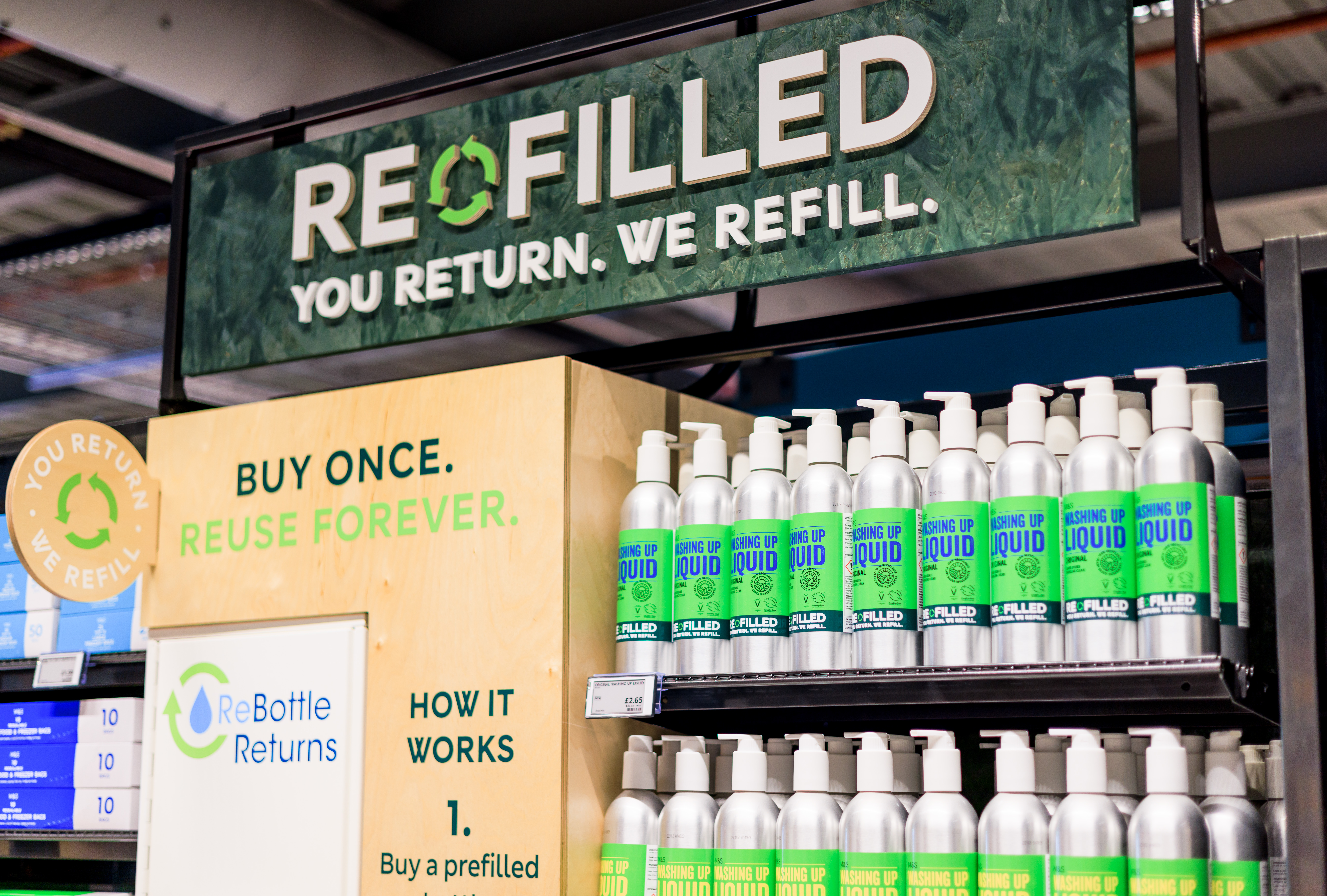
As a business, we are committed to driving circularity and maintaining zero waste to landfill from our own operations and construction activities in the UK and Republic of Ireland. We are working across our value chain to design out waste and to create circular alternatives for the materials, food and packaging we use most.
When products are designed to create minimal waste, every piece of food, packaging and clothing carries less carbon and more value for the people who eat, wear and use it.
Tackling food waste
Around a third of food produced globally is wasted, so cutting food waste in our stores and helping our customers and partners do the same is one of the highest-impact things a food retailer can do for the climate, for food security and for household budgets. We are committed to reducing food waste by 50% by 2029/30 against a 2017/18 baseline, and to redistributing 100% of our edible surplus food via our charity partnerships.

Cutting food waste begins with better decisions at every stage of the journey, from planning and sourcing to store shelves and customers’ kitchens. As we work towards our target to halve food waste by 2029/30 against a 2017/18 baseline, we are refining how food moves through our business, drawing on years of collaboration with WRAP, the Consumer Goods Forum, the Institute of Grocery Distribution, the British Retail Consortium and our suppliers. Our ambition reaches beyond stores and logistics into the supply chain, while also helping customers store and use food more efficiently at home.
Alongside this, we continue to rethink familiar cues that can cause perfectly good food to be thrown away too soon. By removing best-before dates from over 300 fresh fruit and vegetable products and focusing instead on product quality to determine shelf life, we are encouraging a more practical, less wasteful approach to food both in store and at home.
And when surplus does appear, we look for creative ways to give it another purpose and help customers see value in food that is still good to eat. Extra-ripe bananas can find a second life in our discounted “Go Bananas” bags, which offer great-value fruit for baking and include recipe ideas for banana bread and vegan banana muffins. In our in-store bakeries, unsold baguettes and boules can be transformed at the end of the day into frozen garlic bread with a longer shelf life, creating a new product from food that might otherwise have gone unsold. Together, these initiatives show how reduced pricing, smart recovery and product innovation can all play a role in cutting waste while still delivering quality, convenience and value for customers.
Surplus food at the end of the day should feed someone, not the bin. Our partnership with Neighbourly turns daily store activity into hundreds of millions of meals for people who need them most.
We work in partnership with Neighbourly to redistribute surplus food from our stores to a network of community partners across the UK and Republic of Ireland. Since the partnership began in 2015, we have donated the equivalent of 106 million meals to people in need.
Since the launch of our Surplus Food Redistribution app in April 2020, redistributed volumes have continued to grow, and through Neighbourly we have achieved 99% distribution coverage across our stores, with each store paired with at least two good causes. Where this is not possible, we use Neighbourly's "Surplus Saviours" initiative, the first of its kind we have adopted, to connect our late-closing and harder-to-reach stores with community-focused individuals who collect donations of unsold food for local redistribution.
Our store colleagues are also able to take food home that would otherwise have been classed as waste, and our internal policy outlines the approved partners we work with to redistribute food waste from our depots and supply chain. Any food no longer fit for human consumption is collected for anaerobic digestion to produce biogas. As part of the King's Coronation Food Project, we joined Alliance Food Sourcing and other UK retailers to support FareShare, the charity fighting hunger and food waste, complementing the redistribution we deliver every day through Neighbourly.
Managing store and supply chain waste
Our M&S-operated stores, offices and warehouses in the UK and Republic of Ireland produce around 79,000 tonnes of waste annually, all of which is valued and retained in the economy in some form. The majority is transit packaging such as cardboard and polythene, and unsold food. The small amount of damaged goods or clothing generated in our stores is donated to Oxfam or Newlife. We send no operational waste to landfill, in line with our Plan A 2030 commitment to maintain operational waste to landfill at 0%.
We continue to reduce the waste we create, and to improve our approach to fitting out our stores by reusing and refurbishing equipment.

Another Life: extending the life of our clothing
Quality and durability are the starting point for a more circular approach to clothing at M&S. When clothes are made well and made to last, they can be worn for longer, passed on, repaired, resold and, when they reach the end of that journey, recycled more effectively.
That is the thinking behind Another Life, which brings together our approach to extending the life of our clothing through rewear, repair, resale and recycle, helping customers keep products in use for longer and reducing textile waste.

Partnerships and policy
Building a circular economy is bigger than any one retailer; pre-competitive collaboration is how the industry agrees common standards, scales infrastructure and tackles the hard problems no single business can solve.
We support UK Government plans to improve the recycling system and incentivise businesses to use more environmentally friendly or recyclable materials, and we are signed up to the UK Plastics Pact. We are a signatory to the 2030 Courtauld Commitment on food-waste reduction.
We have also become the first UK scaling partner of Circulose, supporting fibre-to-fibre recycling and decarbonisation at scale, and we work with Reverse Resources on post-industrial waste recycling.


